
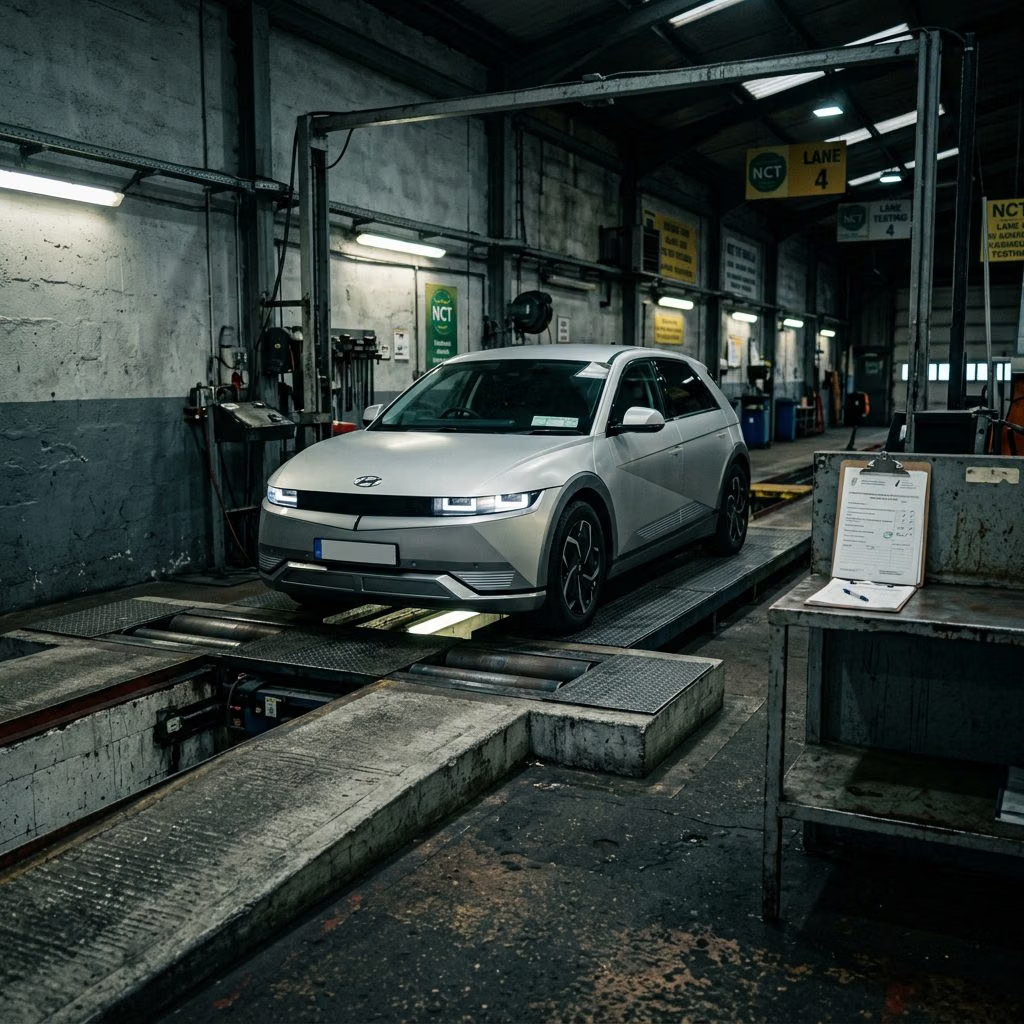
16,779 New EVs — And Most Owners Have No Clue What the NCT Checks
Electric car sales in Ireland jumped 49% in the first four months of 2026. Nearly 17,000 new battery electric cars registered, on top of the hybrids and plug-ins already on the road. Revenue figures from May confirmed that EVs and hybrids now make up 57% of all new car registrations.
A lot of these owners are walking into the NCT centre thinking she’ll fly through because there’s no engine to worry about.
A Dublin mechanic quoted in the Irish Times in April said it straight: “EVs have been sold in Ireland as vehicles that need no maintenance — and people believe that.”
Your EV still goes through the same 56-point NCT inspection as a diesel Passat or a petrol Corolla. Same €60 fee. Same ramp. She skips the exhaust emissions test. That’s it. The other 55 checks? Identical.
And some of those checks are actually harder to pass in an EV.
If your NCT is due and the calendar is showing grey for weeks, our NCT cancellation slot scanner monitors every centre and pings you when a slot opens — most users get one within 2–4 days.
| NCT Check | Petrol / Diesel | EV / Hybrid | EV Risk |
|---|---|---|---|
| Exhaust Emissions | ✅ Tested | ❌ Skipped (BEV only) | No risk |
| Tyres | ✅ Tested | ✅ Tested | 🔴 Higher — heavier car wears rubber faster |
| Brakes | ✅ Tested | ✅ Tested | 🔴 Higher — regen braking lets discs rust |
| Suspension | ✅ Tested | ✅ Tested | 🟠 Moderate — battery adds 300–500 kg |
| Lights & Electrical | ✅ Tested | ✅ Tested | 🟡 Same as ICE |
| Steering & Tracking | ✅ Tested | ✅ Tested | 🟡 Same as ICE |
| Windscreen & Wipers | ✅ Tested | ✅ Tested | 🟡 Same as ICE |
| Bodywork & Chassis | ✅ Tested | ✅ Tested | 🟡 Same as ICE |
The 5 Things Your EV Still Fails On
1. Tyres — she’s 400 kg heavier than you think
A Tesla Model 3 weighs about 1,760 kg. A comparable Golf diesel? Around 1,350 kg. That extra 400 kg of battery sits on four contact patches the size of your palm.
EVs chew through tyres faster. The instant torque off the line doesn’t help. The NCT tester doesn’t care that your car is electric — the 1.6mm tread depth limit is the same. And 14% of all NCT fails in 2025 were tyres.
Get them checked at 3mm, not 1.6mm. And check the sidewalls for cracking. EV-specific tyres are pricier, so people leave them on longer than they should.
2. Brakes — the disc rust trap
This one catches EV owners off guard more than anything.
Most EVs use regenerative braking. Lift off the accelerator and the motor slows the car, feeding energy back into the battery. Grand for range. Not so grand for your brake discs.
Because you’re barely touching the brake pedal, the discs don’t get cleaned by friction. Over months, they rust. Surface corrosion builds up. When the NCT tester puts her on the rollers, the brakes don’t grip properly.
One NCT tester posted in the IEVOA Facebook group: “They have to test the brakes differently on an EV — if they drop it into the rollers, the brakes don’t bite.”
The fix is dead simple. For a week before your test, use the actual brake pedal. Hard stops from 50 km/h a few times on an empty stretch of road. Clean the rust off the discs with friction. Free, takes five minutes a day.
3. Suspension — 400 kg of battery takes its toll
That battery pack doesn’t just wear tyres. It hammers the suspension too. Wishbone bushings, shock absorbers, springs — all under more stress on an EV than on a lighter petrol car.
An imbalance of 30% or more between the left and right sides is an automatic fail. You won’t feel it while driving the N7 to work, but the NCT suspension test plates will pick it up. If you hear clunking over speed bumps, get it sorted before the test.
4. Lights and the 12V battery
Same as any car. Blown bulbs, misaligned headlamps, dodgy reg plate lights. EVs have no special pass here — a €5 bulb will fail you the same as a 2014 Opel Astra.
One thing EV owners forget: dashboard warning lights. Your EV still has a 12V auxiliary battery (separate from the main traction battery). When it starts dying, warning lights appear on the dash. Any illuminated warning light can trigger a fail.
5. Windscreen, wipers, and the small stuff
Cracked windscreen. Worn wiper blades. Empty washer bottle. Seatbelt that doesn’t retract. Missing wheel nut covers.
None of this has anything to do with your drivetrain. All of it will fail you. Run through our 12-point NCT checklist before you go in.
What your EV actually skips
The exhaust emissions test. That’s it.
No exhaust pipe means no CO, HC, or lambda readings. No smoke test. For a diesel owner sweating over DPF regen cycles and oil temperature, that’s a massive relief. For you, it means the test is a few minutes shorter.
EV owners on the IEVOA Facebook group have grumbled about paying the full €60 when the emissions test is skipped entirely. Fair point. The NCTS hasn’t budged on pricing though — you pay the same as everyone else.
If you drive a plug-in hybrid: she still has an engine. She still does the emissions test. Don’t assume you’re exempt because there’s a charging port on the side.
How many EVs are actually due an NCT right now?
More than you’d think. The first wave of mass-market EVs landed in Ireland around 2019–2020. Nissan Leafs, Hyundai Konas, early Tesla Model 3s. Those cars are now 6–7 years old — well into the two-year NCT cycle.
The 2016 surge in hybrid registrations means a load of Toyota Priuses and Hyundai Ioniq hybrids are hitting their 10-year mark this year. That means annual NCT tests from here on.
With wait times still fierce long at centres across the country — Dublin is 24–28 weeks, Cork 12–16 weeks — get a slot sorted early. Check our locations page for your nearest centre, or head to the Dublin NCT booking page if you’re in the capital.
FAQ: NCT and electric cars in Ireland
Do electric cars need an NCT in Ireland?
Yes. Every car over 4 years old needs an NCT — petrol, diesel, hybrid, or fully electric. The test covers 56 inspection items including brakes, tyres, suspension, lights, steering, and bodywork. The only thing a BEV skips is the exhaust emissions test. Plug-in hybrids still do the emissions test because they have a combustion engine.
What do they actually check on an EV at the NCT?
Everything except emissions. Tyres, brakes (including the brake roller test), suspension imbalance, headlamp alignment, steering, windscreen, wipers, seatbelts, bodywork, and chassis condition. The biggest EV-specific gotcha is brake disc corrosion from regenerative braking — use the brake pedal heavily for a week before your test to clean the discs.
How much is the NCT re-test fee in 2026?
A full re-test (lane re-test using equipment like the brake tester) costs €40. A visual-only re-test for minor items — say a blown bulb or worn wiper blade — is free. You have to rebook within 21 days of the original fail or you’ll pay the full €60 again. With EV brake issues being common, most re-tests end up being lane re-tests at €40.